
Fort Cavazos City Directory Collections
The closest concrete city-directory shelf is the Killeen material cataloged by the UT Center for American History. Fort Cavazos records may carry Fort Hood, Camp Hood, Killeen, Copperas Cove, Bell County, or Coryell County wording, so the location field should be tested with the label used at the time. UT's interface accepts a location, a directory type, and an optional year range. Its catalog record is a collection lead, not a finding that a named person appears on a particular page.
| Collection | Years | Where held | Access |
|---|---|---|---|
| Killeen City Directory, R.L. Polk & Co. | 1965, 1970, 1972, 1974, 1976-1978, 1980-1981, 2003 | UT Center for American History index, Killeen and Copperas Cove locations | Catalog metadata; confirm reading-room or copy access |
| Killeen telephone directories | Multiple publishers; exact runs vary | UT Killeen browse results | Name, address, and telephone-era clues after volume verification |
| Bell County archival series | Deeds 1850-1902; deaths 1903-1937 with index toward 1989; marriages 1850-1935 | TSLAC and Baylor microfilm route | Finding aid, repository, or clerk follow-up |
| Digitized Killeen local history | Metadata from the 1890s through the 1970s | UNT Portal to Texas History partner collection | Digital photographs, maps, and early-citizen or library material |
Publication gaps are important. No local page image or entry from a Killeen volume was opened in the research, and no dedicated Killeen reverse-directory run was confirmed on the inspected library pages. That means the volume title, publisher, year, and repository should be written down before a conclusion is made. A missing catalog result may mean the volume is elsewhere, unscanned, or indexed under a different city label.
Fort Cavazos Historical Directory Years
The documented Polk years create useful checkpoints for a Fort Cavazos directory search: January 1965, January 1970, 1972, 1974, 1976 through 1978, 1980 through 1981, and December 2003. They are not a continuous run. Search the closest printed year before and after a known event, then mark the gap rather than filling it with a guessed move date. Killeen and Copperas Cove are both named in the metadata, which makes the city label another search choice, not a substitute for a verified jurisdiction.
A catalog citation is not an entry. The directory may use a different typeface, abbreviation key, street spelling, or household format from another Texas volume. Each volume should be read from the actual page, microfilm, scan, or confirmed copy. If a staff member reports that a volume is missing, save that response with the year and repository. It helps separate an unavailable book from an absent household.
- Search the UT catalog using Fort Hood, Fort Cavazos, Killeen, and the known city label.
- Filter by city, telephone, residential telephone, or other directory type and set a narrow year range.
- Request or inspect the volume, then capture the title page, year, page number, and any abbreviation key.
- Compare the printed street or name with a deed, map, obituary, census, or clerk record from a nearby date.
Reading a Fort Cavazos Directory Entry
Because the research did not inspect a safe Killeen page image, a directory entry must not be reconstructed from a different town's volume. Instead, use a page-review inventory. Copy only the text and marks actually printed in the volume, and keep the page number and publication year beside each field. A printed address is an address at publication time, not proof of an uninterrupted stay or a present location.
| Publication details | Record the title, publisher, year, city label, volume page, and whether it is an image, microfilm scan, or catalog description. |
|---|---|
| Printed name | Preserve initials, spelling, suffixes, and any cross-reference exactly as the volume shows them. |
| Address clue | Transcribe the street form and compare it with a map, plat, or later address only after noting the directory year. |
| Household or work clue | Record a spouse, occupation, business, residence mark, or boarder notation only if the actual Killeen page prints it. |
| Follow-up record | Match the page with a dated clerk, census, obituary, map, or archival source instead of treating the entry as a complete biography. |
- Criss-cross directory
- A street-ordered directory section, when a volume includes one, used to browse addresses rather than names.
- Householder index
- An arrangement that points to the named household reference in a volume; its coverage depends on that edition.
- Abbreviation key
- The publisher's explanation of symbols and shortened words, often near the front of a printed directory.
- Cataloged volume
- A volume described by an institution's metadata but not yet inspected page by page.
Fort Cavazos City Directories and Family History
City directories are most useful as dated family-history clues. Start with the earliest confirmed directory year, then follow the same spelling and address in each available volume. A disappearance can reflect a move, death, a changed name, a missing edition, or a publisher's different listing practice. It is not safe to assign one explanation without another source. Pair the directory year with the relevant census release, a county deed, probate record, obituary, cemetery file, or map.
- Choose an actual page or cataloged volume tied to a name, address, or year.
- Make a source note that includes the directory's city label and the Fort Hood or Fort Cavazos alias if used.
- Check the next available directory year rather than assuming annual coverage.
- Use the National Archives census schedule available for the period as household context, remembering that census releases follow a 72-year rule.
- Confirm a key address or relationship with a clerk, archival record, or collection citation.
The federal census can place a household in a date-bound county or city setting, but its geography may not match a current Fort Cavazos CDP or installation boundary. The National Archives census records route identifies the 1950 schedule as the latest full decennial census generally available as of the research date. Directories fill some gaps between census years, while maps and recorded instruments test whether a street or parcel meaning has changed.
Fort Cavazos Directory Research Help
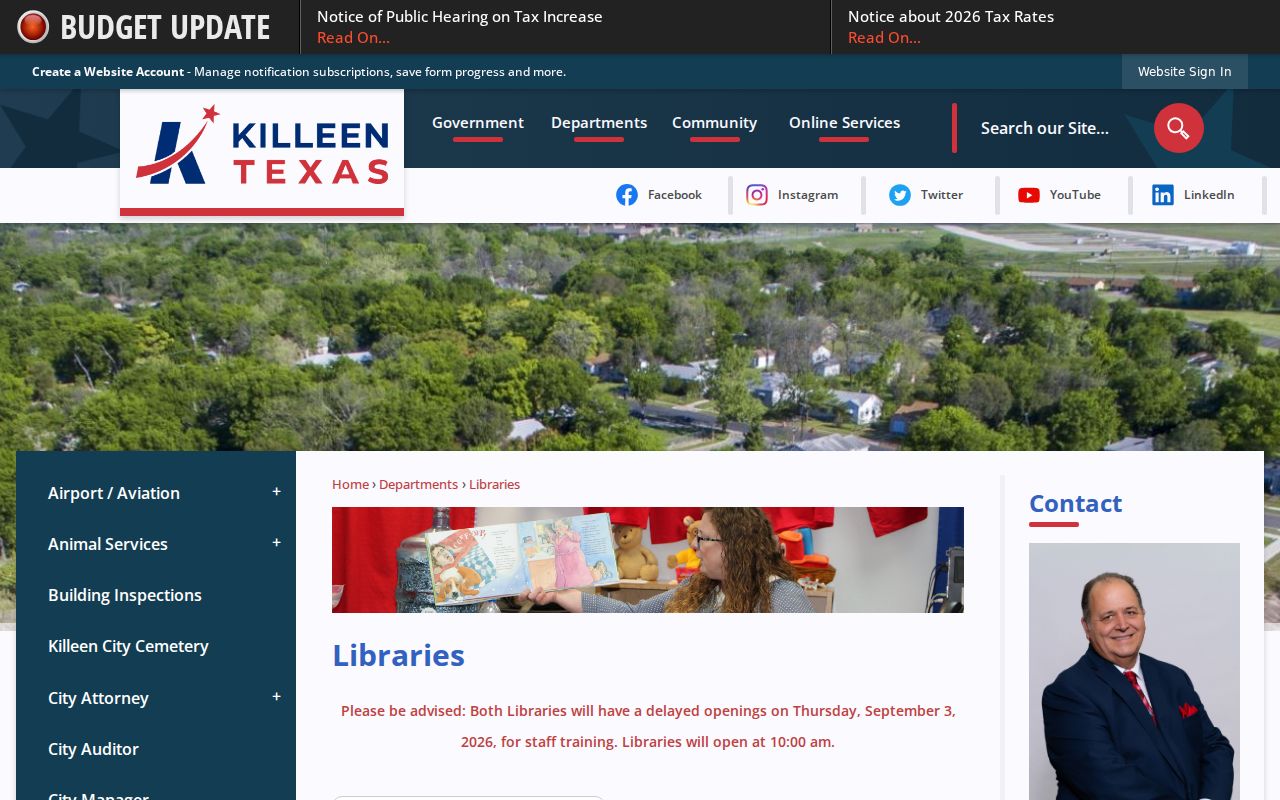
When online metadata stops, Killeen Public Library offers a practical reference route. The Main branch is at 205 E Church Avenue, and the research lists its reference desk at 254-501-8808. The official library page also lists the Copper Mountain branch, catalog searching, electronic-resource links, and print or copy access shown at $0.10 per page. Hours vary by branch and should be checked on the current page before a visit. Ask whether a particular city or telephone directory, microfilm title, or obituary resource is held locally.
Here is the assigned capture of the Killeen Public Library system, which provides the branch and reference-service route.
A narrow request with a surname, address, date range, and desired collection is more useful than an open-ended request to search an entire family.
Fort Cavazos Archive Directory Backstops
County archives extend the city-directory trail beyond printed volumes. The TSLAC Bell County inventory identifies deed records from 1850 through 1902 with index reels, death records from 1903 through 1937 with an index extending toward 1989, marriages from 1850 through 1935, probate records, and civil papers. Baylor is listed as a regional repository for Bell and Coryell materials. These runs can turn a directory lead into a dated record request or microfilm search.
Coryell's holdings offer a different historical shelf: marriages from 1854 through 1956, tax rolls from 1855 through 1910, probate minutes from 1854 through 1934, jail registers from 1891 through 1943, scholastic census records from 1926 through 1946, and medical-register material from 1907 through 1969. Treat each series as its own context. A tax roll may show taxable presence, while a probate record may show an estate relationship. Neither creates a modern resident list.
Note: Microfilm and archive descriptions can be incomplete or unindexed, so save the reel number, collection title, date range, and repository with every historical result.
Killeen Digitized History
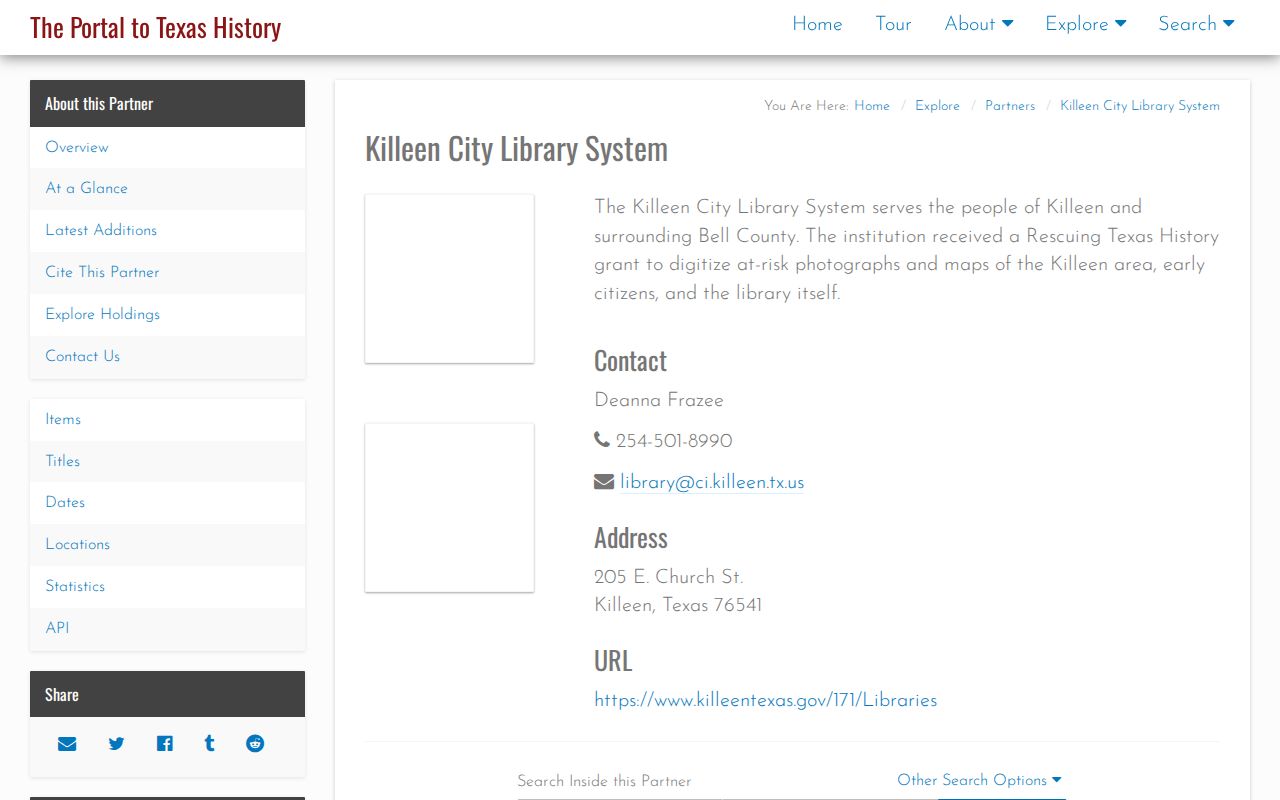
The Killeen City Library System partner collection at the Portal to Texas History supplies a digitized place layer rather than a complete directory. Its metadata shows 198 items, including 194 Bell County items, with photographs, maps, early-citizen material, and library material. Search by street, school, organization, neighborhood, surname, or collection title. An image caption can suggest a place or date, but it should be corroborated before it is connected to a person.
Here is the assigned capture of the Killeen digitized-history collection, a useful companion when a directory volume gives a location but not its wider setting.
Pair a digitized image with its item metadata and a separate dated record, especially when the source uses a legacy Fort Hood or Camp Hood name.
Sanborn and Military Maps
Maps test the place named in a directory. The Library of Congress Killeen Sanborn item covers 1926 through 1937 and has seven sheets. A Sanborn sheet can show a building footprint, use, block relationships, adjacent streets, and some construction clues. It does not identify every occupant. Pair the map date with a directory date, tax roll, deed, or later aerial source so that a building's physical presence is not confused with a claim about the people associated with it.
The 1982 Fort Hood military map is a different kind of source. It describes installation geography and facilities rather than civilian household information. This distinction helps when an old Fort Cavazos city directory search fails: the address may be a historic installation facility, a renamed road, or a place outside a city directory's scope.
Fort Cavazos Directory Growth Story
Directory gaps around the installation sit within a larger record story. Camp Hood was activated during World War II, Fort Hood became permanent in 1950, and Killeen grew from 7,045 people in 1950 to 23,377 in 1960 and 35,507 in 1970. That change put pressure on roads, schools, and public services. It also helps explain why a research trail may move between a rural county record, a Killeen city source, an installation document, and later suburban address systems.
The name history remains part of the search method. USPS recorded the Fort Hood-to-Fort Cavazos change for ZIP 76544 in 2023, while some Army pages retrieved in 2026 use Fort Hood. Preserve the wording and date seen in each directory citation. Searching both names is more reliable than deciding that a historical source has the wrong place name.
Fort Cavazos Directory Timeline
Use the record dates as checkpoints, not as a claim that one collection continues without gaps. The archive route changes from county books and microfilm to cataloged Killeen volumes and then to digitized place collections. The timeline keeps the source format visible when comparing a historical address.
| 1850-1902 | Bell deed records in the TSLAC inventory provide an early property-record backstop. |
|---|---|
| 1926-1937 | Library of Congress Sanborn sheets document Killeen building and block context. |
| 1965-2003 | Cataloged R.L. Polk Killeen volumes appear at the documented, noncontinuous dates. |
| 2023 | USPS records the Fort Hood-to-Fort Cavazos postal change for ZIP 76544. |
Fort Cavazos Directory Limits
A Fort Cavazos directory volume is a historical pointer, not proof of current residence, continuous occupancy, ownership, family relationship, or military status. It may omit people, use a publisher's local conventions, contain printing errors, or represent only the year of publication. A Killeen directory does not convert Fort Cavazos into a city, and a postal label does not resolve the Bell and Coryell split. The right response to a conflict is to retain each source date and contact the relevant archive or custodian.
Use dated sources. Favor old, lawful research and corroborate a directory lead with an archival or official record. Do not use historical collections to expose protected or current private contact information.
The Bell County Museum keeps research and genealogy materials for in-library use, while the Bell County Historical Society offers research by appointment. These access limits are useful information, not dead ends. Bring the collection title, a surname variant, an address or community, and a short date range so staff can direct the request to a shelf, finding aid, or appointment.